


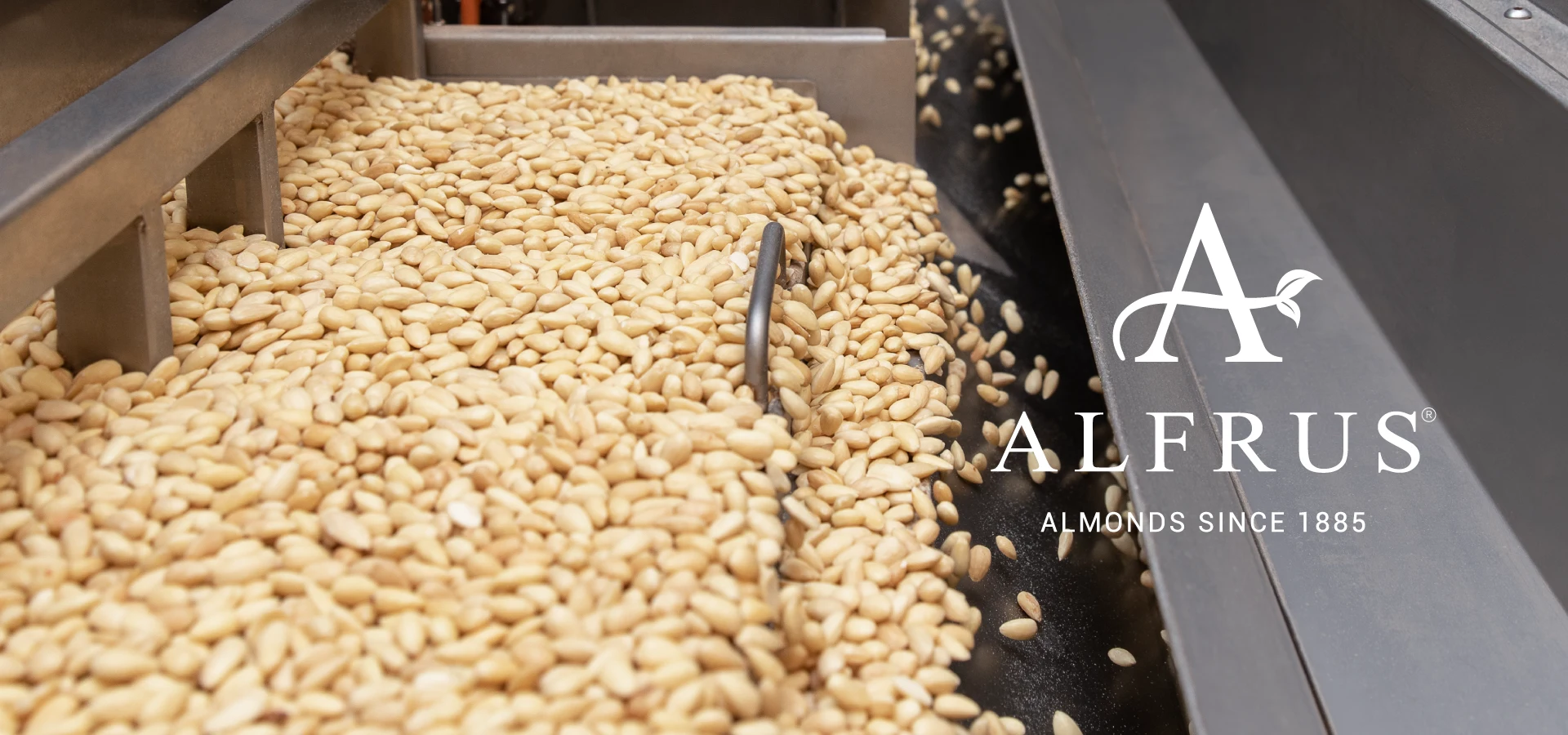
How does almond blanching work at Alfrus?
In the food industry, blanched almonds are a highly valued ingredient.
Removing the outer skin results in a product with a more uniform appearance, a milder flavour, and characteristics that make it particularly suitable for applications where aesthetics, precision, and visual and sensory balance are essential, such as creams, ice cream, doughs, toppings, bakery products, and premium food preparations.
Blanching is more than a simple mechanical operation. It is a process that requires careful control of multiple operational variables. At Alfrus, it is carried out through a natural process that relies exclusively on hot water and advanced processing technologies, without the use of chemical treatments.
The objective is to remove the almond skin through a combination of thermal treatment and mechanical processing while preserving the kernel’s structure, nutritional properties, and organoleptic characteristics. The skin serves as a natural protective layer and contains compounds that define the almond’s colour and flavour profile; however, these characteristics do not always align with the application requirements of the food industry.
Before processing begins, the almonds are first dedusted using drum systems and then undergo preliminary inspections through two different optical sorting systems. These technologies identify and remove any foreign materials as well as defective kernels, ensuring that only compliant almonds proceed to the blanching stage.
During the first processing step, the almonds are immersed in hot water at 90–100°C for 2–5 minutes, allowing the skin to separate naturally from the kernel. The heat softens the skin, facilitating its subsequent removal by food-grade rubber rollers, which gently remove it without causing breakage or surface damage.
Once blanching is complete, the almonds are dried and cooled to stabilise the product, eliminate residual moisture, and prepare it for the subsequent processing stages.
Before packaging or any further processing, the almonds undergo an additional round of quality inspections through an integrated inspection system combining digital sorting machines and metal detectors capable of detecting non-conforming kernels, visual or structural defects, foreign materials, impurities, and potential contaminants.
These digital controls are complemented by analyses carried out in our in-house laboratories, where key quality parameters are monitored to ensure food safety and compliance with international industry standards.
The final stage of the process is size grading. Using advanced grading systems, the almonds are classified according to dimensional specifications, ensuring uniform size grades that meet each customer’s processing requirements.
Thanks to the flexibility of its production processes, Alfrus is able to provide customised solutions, supplying blanched almonds in customer-specific size grades, while ensuring batch uniformity and production continuity.
Almond blanching clearly demonstrates the level of expertise and the highly specialised approach required in almond processing.
Colour consistency, kernel integrity, the absence of skin residues, dimensional uniformity, and food safety all directly affect the performance of almonds in subsequent industrial applications.
In food manufacturing, quality is never accidental. It is the outcome of every technical decision made throughout the production process.
1st July 2026