

Plant-based spreads: a growing market between innovation and evolving consumption habits
The European food sector is undergoing a structural transformation driven by changing consumption habits and the rise of plant-based solutions, now no longer perceived as simple alternatives, but as categories fully integrated into everyday eating habits.
According to the latest analyses, the plant-based food & beverage market in the main European countries has exceeded €16 billion, confirming the strength of the trend and its consolidation beyond a niche dimension. Three key factors are shaping this evolution: health awareness, nutritional value, and affordability.
Within this scenario, nuts and seeds play a central role, accounting for nearly half of the category’s total value sales. Demand is increasingly shifting towards products capable of delivering tangible benefits such as protein intake, energy, and digestive health support, adapting to the pace of modern lifestyles.
The boom in spreads
Among the most dynamic categories, spreads stand out, showing significant growth in Italy as well. In 2025, the segment reached a value of nearly €576 million, with a +7.6% increase in value and a +2.8% growth in volumes compared to the previous year.
These figures reflect more than market performance: they signal a category evolution. Greater variety, expanded flavour profiles, and new consumption occasions are reshaping the market. In particular, almond-based products are experiencing strong acceleration, with increases above +40% in value and over +50% in volume, supported by increasingly positive consumer perceptions associated with naturalness, nutritional balance, and functionality.
In this context, large-scale distribution continues to play a key role, expanding product assortments and responding to a more segmented and demanding consumer base.
Behind this growth lies the increasing importance of plant proteins and a clear shift in how consumers make purchasing decisions. Today’s consumers are more attentive to ingredient composition, favouring plant-based ingredients, transparent labelling, and formulations free from additives and added sugars. The key purchase drivers are clear: ingredient quality, label transparency, naturalness, and versatility.
Within this framework, almonds confirm their position as one of the most strategic ingredients for the food industry. Beyond their nutritional profile, they offer natural creaminess, stability, and palatability without requiring complex formulation processes, while ensuring ease of use across multiple applications.
Their neutral sensory profile also allows for broad flexibility, making them suitable for both sweet and savoury products. In this sense, almonds represent a raw material fully aligned with the market’s new requirements, enabling innovation within the category.
Alfrus’ innovation: the new almond paste
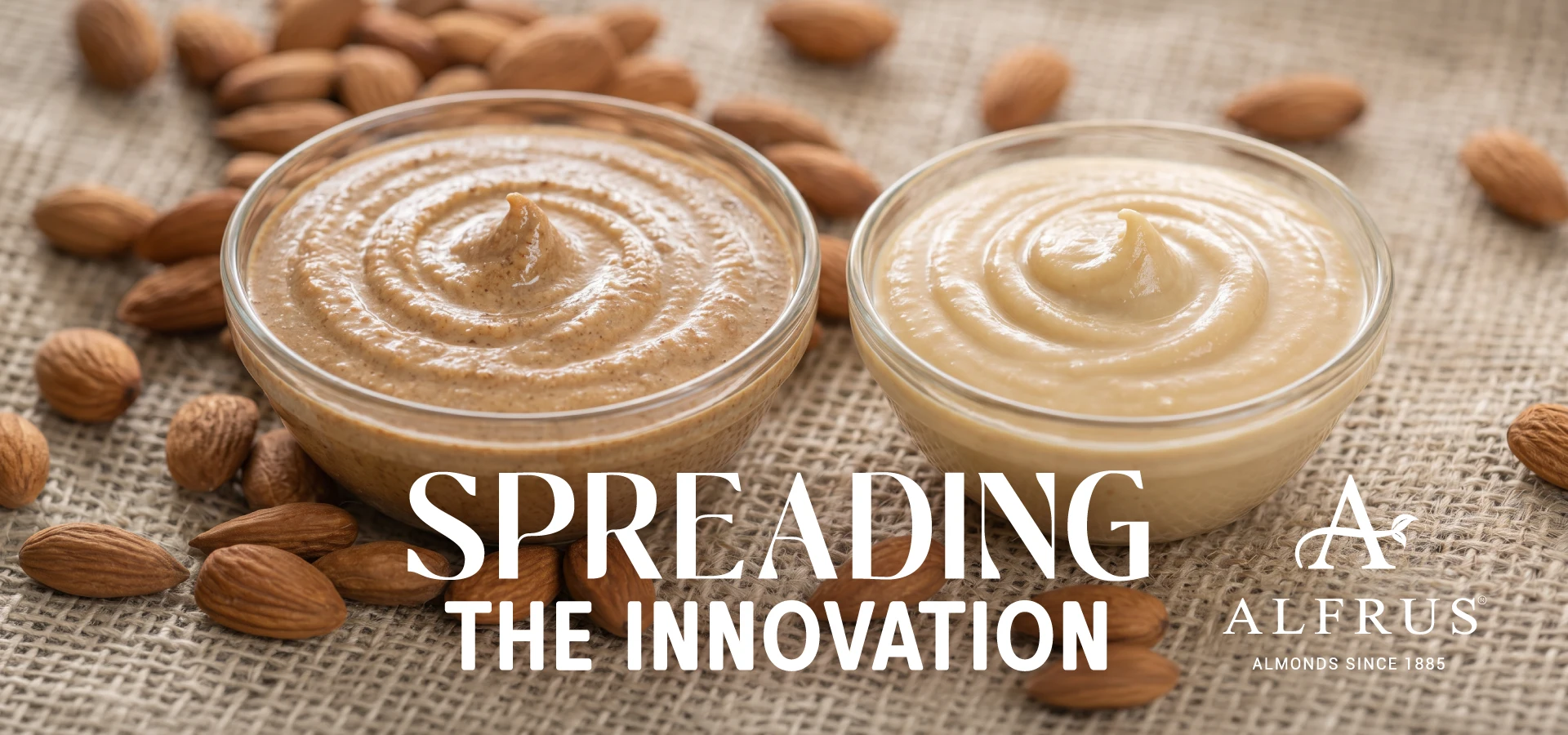
It is precisely in response to these dynamics that Alfrus expands its offering with a new product: an almond paste developed to meet the application needs of the food industry.
This is a spread obtained from natural roasted or blanched roasted almonds, processed to achieve a fine, smooth and homogeneous consistency, with an intense and rich aromatic profile.
The product stands out for its versatility across a wide range of applications, making it suitable both for direct consumption and for use as an ingredient, with multiple uses including bakery and pastry fillings, ice cream bases, dessert toppings, sweet and savoury preparations, and applications within the plant-based segment.
One of its key differentiating factors is customization: roasting level, particle size, and viscosity can be adjusted according to each client’s production requirements.
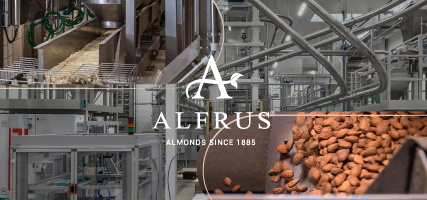
The highly controlled production process is designed to reduce particle size and ensure full homogenisation of the product through progressive refining systems and continuous monitoring of key parameters such as uniformity, colour, and viscosity.
In this context, Alfrus almond paste goes beyond the concept of a simple range extension, demonstrating how a company can transform a raw material into a high-value industrial ingredient.
4th May 2026