




How to unlock global almond demand
Almonds are taking center stage in health-conscious nutrition. As nutritionists and doctors highlight their benefits, the food industry is increasingly recognizing their application potential, incorporating them into a growing number of products and formulations.
In the past year alone, nearly 10,000 new almond-based products have entered the global market. This is a clear sign of rising demand, with innovation acting as the main driver of consolidation and growth.
The Almond Board of California is actively exploring new development opportunities, focusing on three strategic levers: market profitability, operational feasibility, and consumer appeal.
The global consumer
The key to success lies in the ability to meet the needs of an increasingly informed, demanding, and selective consumer, who pays close attention to nutrition, functionality, perceived quality, and label transparency. This is combined with a preference for high-protein, fiber-rich, and low-sugar ingredients, incorporated into convenient products aligned with dynamic lifestyles.
Snack culture, particularly among younger consumers, is growing: data shows that Gen Z consumes more than one snack per day and, in some cases, replaces main meals with snacks. In this context, almonds emerge as a versatile ingredient, suited to new consumption patterns and innovative products.
Research by Innova Market Insights identifies six key food trends for 2026: protein, gut health, indulgence, beverages, plant-based nutrition, and mental well-being. Almonds, as a 100% plant-based and natural ingredient, fit perfectly into all these areas, opening up endless innovation opportunities for producers.
High-potential markets
Geographically, the United States remains the leading market for launching new almond-based products, particularly in the premium and functional segments. India is growing rapidly, with consumers increasingly focused on health, quality, naturalness, sustainability, and convenience—factors that, combined with strong economic momentum, are driving the expansion of applications. Thanks to its strong beverage culture, Asia accounts for around one-third of new product launches in 2025, confirming its role as a key market for developing new almond-based consumption experiences.
Italy also plays an important role, ranking third in Europe, with a strong focus on almonds’ innovation, appreciated both for everyday consumption and culinary use. Collaborations between the Almond Board of California and Italian academic institutions, such as the University of Palermo, are exploring new application frontiers beyond snacks and confectionery, including savory cuisine and food service, with the aim of expanding their use.
Data from large-scale distribution confirms the sector’s growth: in 2025, purchases of nuts exceeded €1.1 billion. Average annual per capita consumption reached 4.5 kg, with shelled almonds leading in market share (22%). This expansion is driven primarily by product innovation, which has broadened the offering and multiplied consumption occasions.
At the same time, the role of nuts as an industrial ingredient is strengthening: approximately 55% of available nuts are destined for processing in traditional confectionery and new applications such as beverages and plant-based alternatives. Therefore, the role of nut processors is becoming increasingly central.
The role of Alfrus
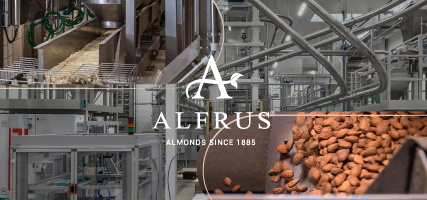
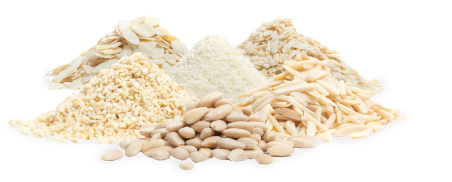
In a market characterized by complex and segmented demand, the real challenge is to translate consumption trends into concrete industrial applications. This is where Alfrus positions itself, combining production flexibility, technical expertise, and food safety, operating as an industrial partner for food companies and developing high value-added ingredients for various end applications: from bakery to plant-based alternatives, as well as snacks and beverages.
Thanks to the flexibility of its advanced facilities, Alfrus can manage both large-scale and customized production, adjusting variables such as formats, particle sizes, and processing levels. Its in-house laboratories also support clients in developing new products, reducing time-to-market and facilitating entry into emerging market segments. At the same time, Alfrus ensures the highest quality standards throughout the supply chain through meticulous control systems and certified processes.
In this sense, Alfrus does not merely capture the growing demand for almonds, but actively contributes to making it accessible, applicable, and replicable at an industrial level.
The future of the almond industry depends on companies’ ability to translate trends into real opportunities. It is not enough to meet demand: supply chains must be capable of activating, channeling, and consolidating it.
30th March 2026